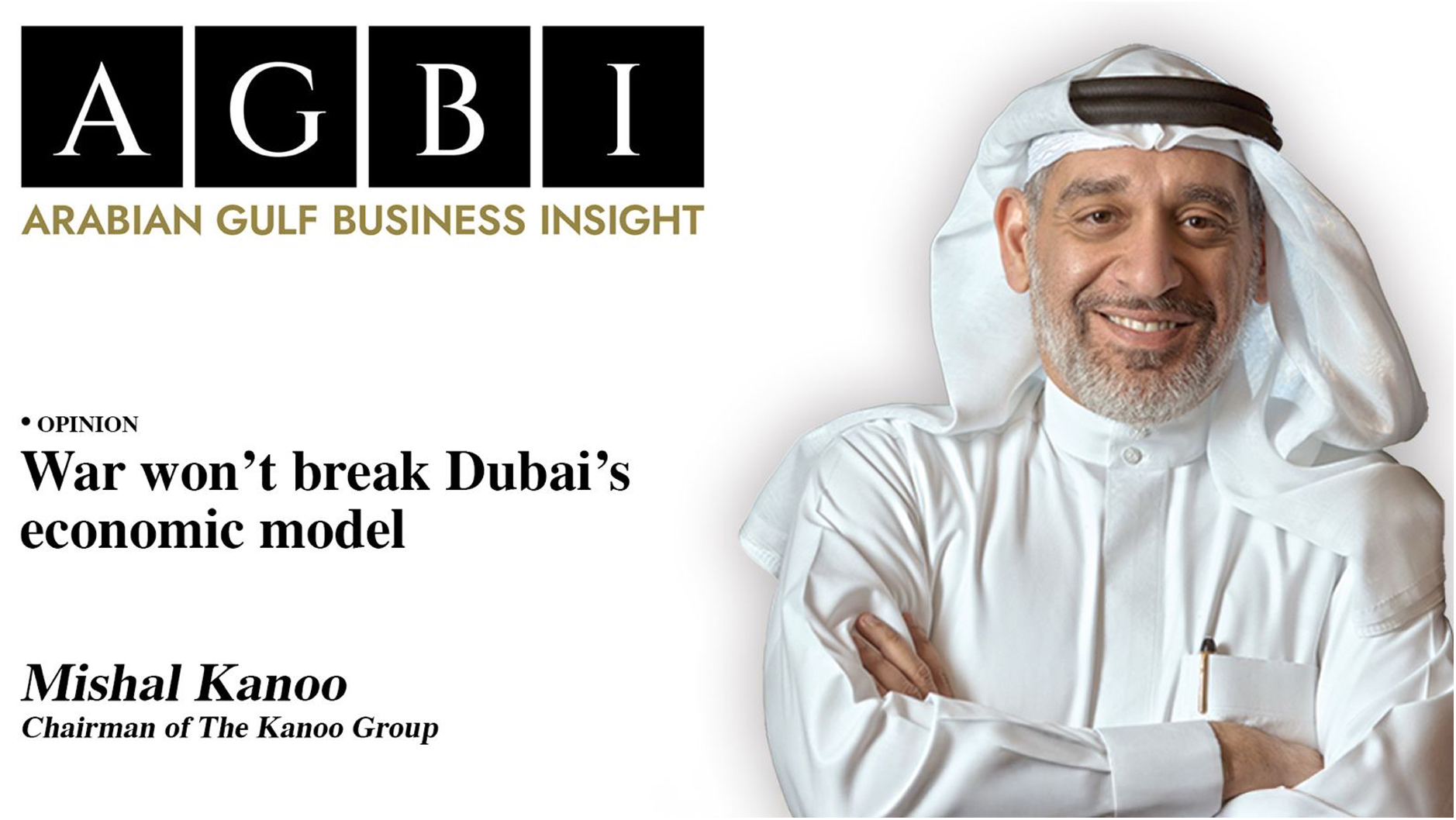
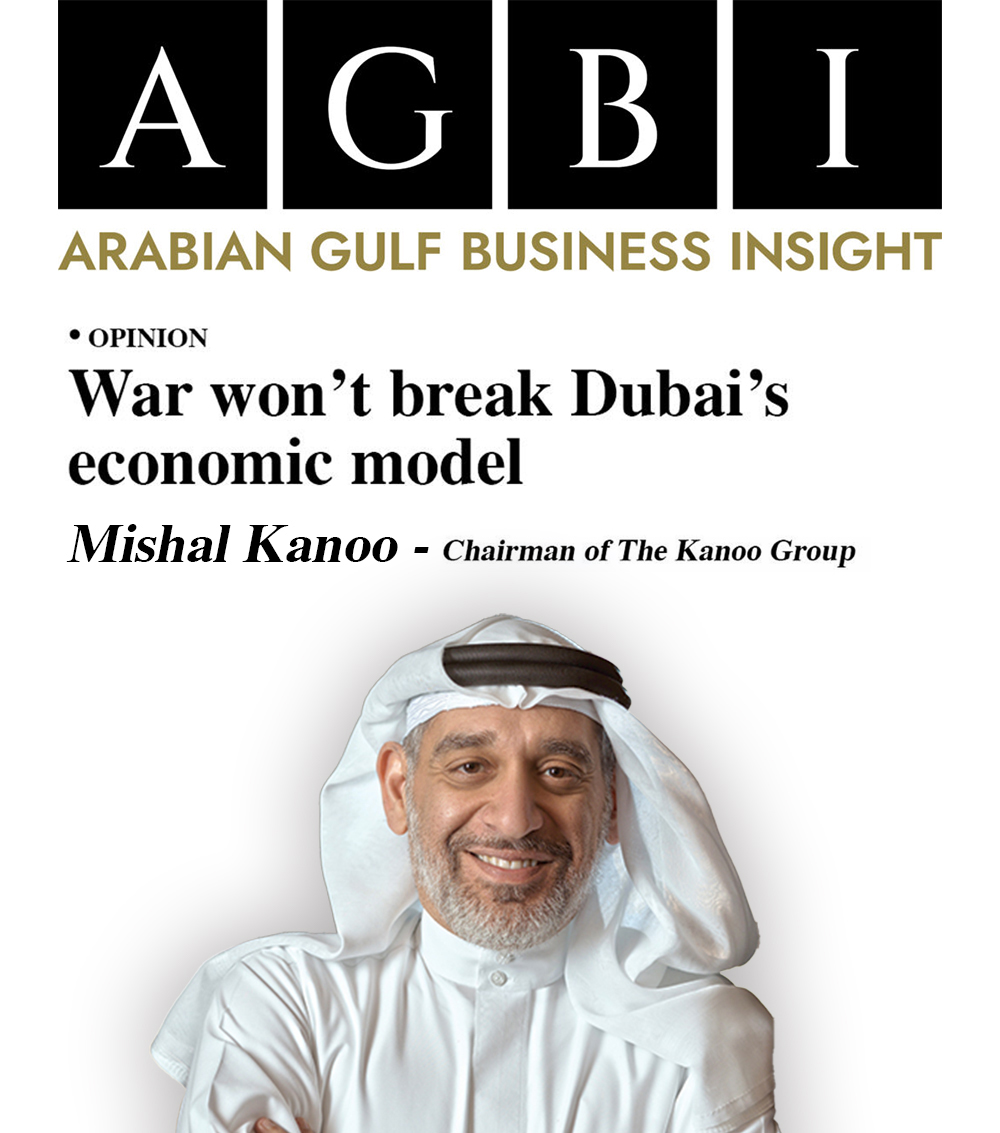
Exclusive interview by Megha Merani published at AGBI - Arabian Gulf Business Insight
The chairman of one of the UAE’s largest family conglomerates says the country faces a painful economic reckoning from war in the Gulf but argues that global narratives declaring Dubai finished say more about its critics than its fundamentals.
“The Germans have an expression [for it] – schadenfreude,” says Mishal Kanoo, chairman of Dubai-headquartered Kanoo Group and AGBI columnist.
“[It means that] you enjoy watching somebody else suffer.”
Since the US and Israel launched strikes on Iran in late February, Tehran has fired hundreds of missiles and drones at Gulf states.
The UAE has borne the brunt, with air defenses detecting large numbers of projectiles aimed at the country.
While most were intercepted, images of debris falling over Dubai sparked alarmist headlines predicting the collapse of the emirate’s economic model – widely seen as one of the region’s most successful diversification strategies, built on non-oil sectors such as tourism and property and its status as a tax-free safe haven for global capital.
Many of those taking pleasure in the crisis, Mishal Kanoo says, are the same foreigners who built fortunes here during the boom years.
“They’re happy to enjoy other people’s demise.” The ones who draw his sharpest criticism are British journalists and visitors, “who come here, make a ton of money, enjoy life, have fun… Then when things go wrong, they say, ‘See, I told you’.”
Inside the country, where more than 90 percent of its residents are foreigners, he says, the crisis looks very different.
“I have seen people from different parts of the world who live here saying: ‘No, we’re happy. This is a good place. We are [just] experiencing a horrible situation.’”
Kanoo acknowledges the shock. From his vantage point – his family’s group of companies spans travel, shipping, logistics, energy and industrial services – the economic effects will vary widely.
The Kanoo Group, which traces its origins back to a small trading business established over 132 years ago as the Yusuf Bin Ahmed Kanoo Group, established by Kanoo’s cousin in Bahrain in 1890, employs more than 1,200 people today.
The first to feel the blow will be tourism, which contributes more than $70 billion to the UAE’s economy and roughly 13 percent of GDP, he says.
“It will take months – maybe a year or so – and then people come back again, because there’s a lot here, they can enjoy at a reasonable price.”
Real estate may face a deeper correction. Dubai’s property market has surged for five consecutive years, fed by waves of wealthy foreigners buying multi-million-dollar homes and a golden-visa program granting long-term residency to property buyers.
The war may bring that trajectory to a halt. “Honestly, the market had seriously overheated… If prices come down to something more reasonable, that’s not a bad thing,” Kanoo says.
The shakeout, he argues, will reveal a divide between residents and speculators.
“Money is a coward,” he says. “Those who were just flying in for quick profits will leave.”
Long-term residents may instead see an opportunity: “If developers target people who want to live here long term, and they price reasonably… then you have customers,” he says.
But Mishal Kanoo believes fears of a mass exodus of capital are exaggerated. Financial centers everywhere experience ebbs and flow of money, he says.
“Whether you are in Singapore, London or Switzerland, money comes and goes. It depends mostly on regulators and structures, and opportunities.”
In 2025, the UAE attracted more millionaires than any other country in the world – about 9,800 high-net-worth individuals bringing $63 billion in wealth, according to migration consultancy Henley & Partners.
Wealth managers have flocked to the Dubai International Financial Center, where family offices manage more than $1.2 trillion in assets. Next door, Abu Dhabi’s sovereign wealth funds control about $1.7 trillion – a concentration of capital that has drawn international financial heavyweights from Brevan Howard to Ray Dalio’s family office to the emirate’s financial center ADGM.
Unless regulatory frameworks radically change – a scenario Kanoo considers unlikely – he expects only modest shifts of 2 to 5 percent.
“To say an exodus [of capital], 30 to 40 percent, it really must take a lot,” he says. “Last I checked, we still have a good defense of the country and nothing has changed as far as legislation is concerned.”
Some foreign investors may hesitate, he acknowledges.
For Kanoo, the reaction to the attacks reflects a broader misunderstanding of the region.
Over the past three decades the UAE has weathered wars, financial crises and political upheaval – from the Gulf War in 1990 to the 2008 global financial crisis and the 2020 pandemic.
“We’ve experienced enough blips and huge jolts… and we’ve survived, and grown bigger, and been more attractive to people,” Kanoo says.
“I don’t see this being any different. In the moment, it’s hard to convince people that this is the case. But we are extremely lucky in having the right leaders.”
The difference, he says, is how people define risk. The bigger danger now is not the drones overhead but if the conflict expands.
“I’m more afraid if things escalate… if it stays limited to this, eventually everyone runs out of ammunition… it stops. But if it spreads, that becomes much harder to control.”
For Kanoo personally, the decision about whether to leave the country never arose.
“I cannot expect, with all this madness happening around us, to say it’s business as usual. It cannot be the case,” he says.
“But this is my place. This is my backbone. My kids live here. My business is here. In the good times, I benefited from it. I’m certainly not running away when bad times happen.”
“Dubai’s success will not just be because I want it to succeed. It will succeed because people from all over the world have a vested interest in making sure it does.”